
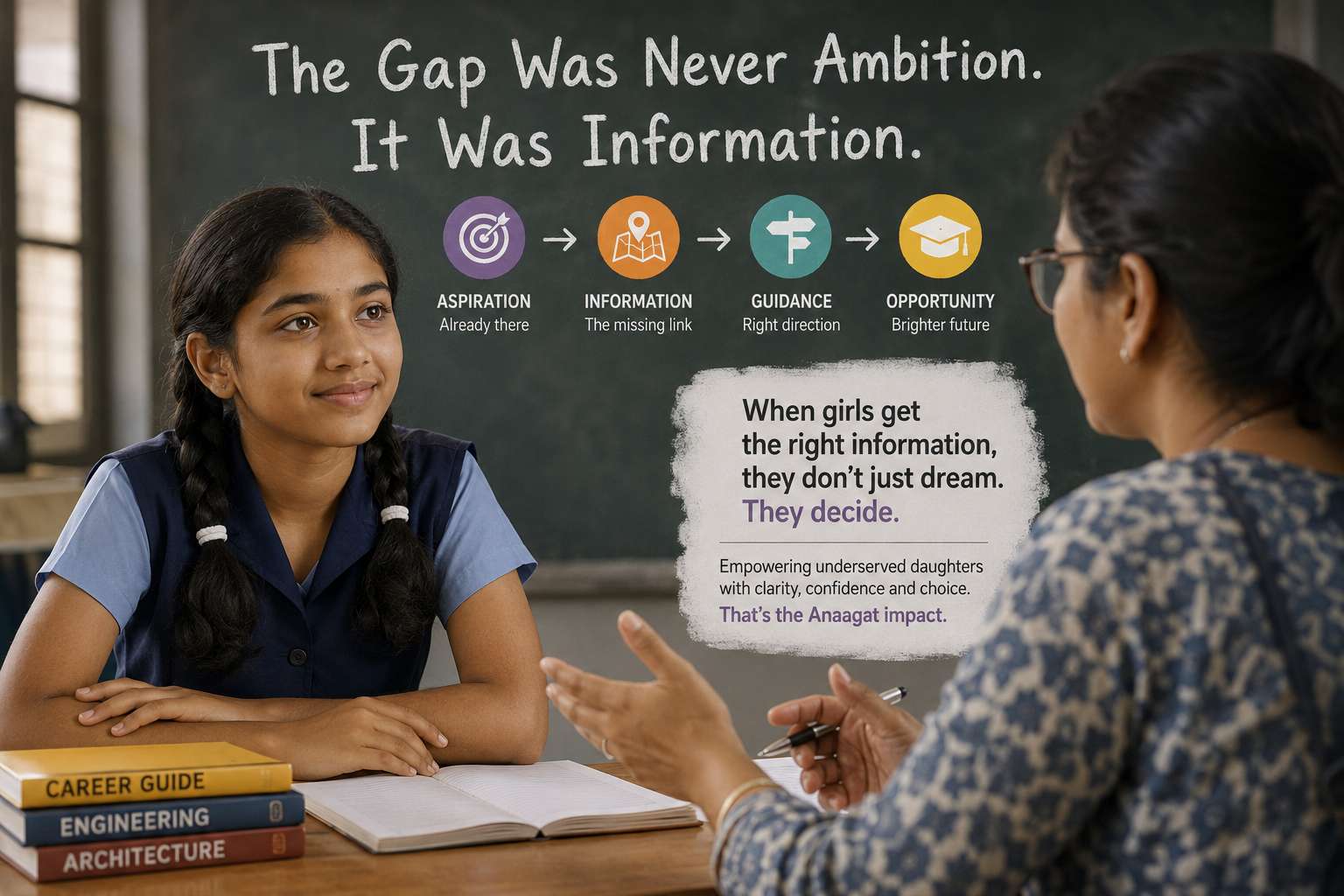
What the impact data behind Anaagat actually shows about India’s underserved daughters
Authored by Nikhar Arora, Founder & CEO, Anaagat by Mentoria
Student names have been changed to protect their privacy.
Priya is in Class 8, in a village in rural Maharashtra. Her family gets by on a daily wage. When our counsellor asked her what she wanted to become, she did not name something small or safe. She said AI Engineer.
A few districts away, a Class 10 student we’ll call Meena sat for the same programme. She is being raised in a single-income household getting by on a few thousand rupees a month. After a psychometric assessment and one honest conversation, she chose to pursue architecture.
I have spent a decade being told what girls like Priya and Meena supposedly need: modest goals, realistic expectations, a vocational skill that fits their circumstances. The data we have gathered across our programmes says something almost the opposite, and it is the single most important thing I have learned in building Anaagat. The binding constraint in the education of India’s underserved daughters is not aspiration. It is information.
What the assumption gets wrong
The dominant instinct in this sector, and mine once too, is to treat a poor rural girl as someone who needs her ambitions managed downward toward what is achievable. But when you actually put a scientific assessment and a trained counsellor in front of her, the ambition is already there, fully formed. What she has never had is a map: a structured way to connect what she is good at to a path she can realistically walk.
Across the cohorts we have run, the careers girls name after counselling are not modest. They are Chartered Accountant, Computer Software Engineer, Architect, Veterinarian, Agronomist. These are girls from households earning between ₹2,000 and ₹16,500 a month. The gap between them and those careers was never desire. It was that no one had ever shown them the route, at the one academic moment the route still branches.
This matters for CSR because an aspiration problem and an information problem call for completely different, and differently priced, interventions. If the problem were aspiration, you would fund inspiration: awareness drives, motivational events, the programmes that fill impact decks with large reach numbers and photographs and whose effect no one can measure a year later. If the problem is information, you fund something more structured, harder to deliver at the last mile, and, crucially, measurable.
The evidence that it is measurable, and that it works
Anaagat is not asking for an act of faith. It is built on a model Mentoria has been running and measuring since 2015, across more than 350 schools, reaching over 3.75 lakh students. That decade is what lets me make claims about outcomes rather than intentions.
The longest-running version of this model is Project Anando, our partnership with the Light of Life Trust, which has reached 19,311 children directly across Maharashtra, Madhya Pradesh, Rajasthan and Odisha. In the communities where structured career counselling has run longest, 56 percent of the girls who came through the programme went on to pursue higher education, against 26 percent of comparable girls across the same districts.
In those same communities, we have also seen the average age of marriage rise, from 16 to 22. I do not read this as the product of a campaign against child marriage. It tracks with something narrower: girls who gained clarity and direction made different decisions about their own futures. I offer it as an association we have observed alongside the counselling rather than a cause I can prove, and it is worth stating precisely because it is measurable.
Beneath those longitudinal figures sits the granular, unit-level evidence that tells you the delivery is real. Through the Daughter’s Day Futures Fund, we funded the complete career journeys of 2,000 girls, one by one, between October 2025 and April 2026. Every cohort that ran to completion did so at a zero percent dropout rate, in exactly the population where dropout is supposed to be inevitable. Zoom in further, to a single cohort of 200 girls supported by a corporate partner across five semi-rural communities: 100 percent completion, every girl assessed and counselled individually. In another cohort, when we asked the girls themselves to rate their clarity about their career path afterward, 80 percent rated it four or five out of five, and 84 percent said the same of the support they received. Those are outcome numbers, reported by the children, not activity counts we generated for a report.
I share them to make one narrow point: this level of measurement is possible, even in the hardest-to-reach communities. If it is possible, it changes what a funder can reasonably expect. The programmes that can answer a narrower question, not how many children did you reach, but what did you measure at the level of the individual child, are a different category from the ones that cannot. That distinction is the one worth caring about, and it is available to anyone who looks for it.
Why this is the highest-leverage rupee in the room
The information gap has an unusual property for a social problem: it is cheap to close. The complete journey for one girl through Anaagat, from her first psychometric assessment through structured counselling and career mapping to ongoing support from Arya, our AI career agent, all the way to her first job, costs ₹5,000. Reaching a child through a trained government-school teacher, who then carries that capability to fifty new students every year she stays in service, costs roughly ₹240. These are not the economics of an intractable problem. They are the economics of a problem that has simply been mislabelled.
I want to be careful not to overclaim, because the temptation in this sector is real. A girl naming “AI Engineer” in a counselling room has not become one. Clarity is the first mile of a very long road, and I have no data telling me how many of these girls will reach the careers they named. What I can say, with evidence gathered over a decade, is that we have removed a specific, identifiable barrier at the exact moment it does the most damage, and that girls respond to its removal immediately, consistently, and at a scale that can be measured and reported.
CSR in girl-child education has, rightly, spent a generation building access: schools, scholarships, enrolment. The next frontier is not access. It is equipping the girl who is already in the system with the information to navigate what comes after it. That is a smaller, sharper, more measurable problem than the one we have been treating it as. Anaagat exists because we found the evidence that it is solvable, and because a girl in a village like Priya’s who can name AI Engineer as her goal has already done the hard part. The rest is just making sure someone reaches her in time to hand her the map.
Nikhar Arora is Founder & CEO of Anaagat by Mentoria, a national initiative preparing India’s underserved daughters, and the teachers who shape them, for a future being reshaped by AI. Anaagat is built on Mentoria’s decade of career-guidance delivery across India.
